Community
In Times of Chaos, Does AI Matter? A Crisis Case Study
When everything falls apart, does Artificial Intelligence hold up? A reflection on natural disasters and a case study of how technology helped organize chaos and save lives in Portugal.
7 min read · Jun 15, 2026

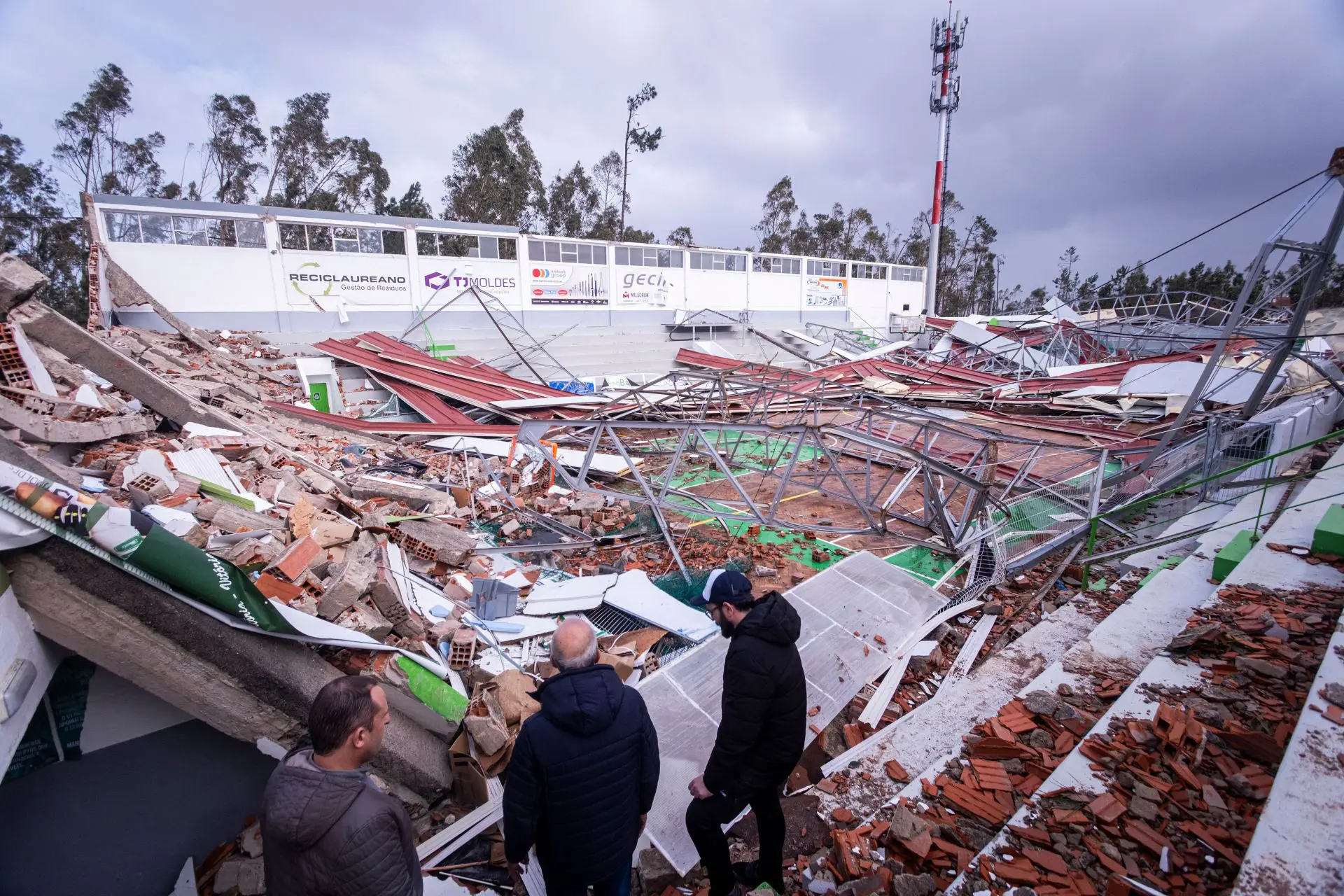
Today, July 28, marks exactly six months since one of the darkest dawns in Portugal’s recent history. On January 28, Storm Kristin — classified as an “explosive cyclogenesis” with wind gusts exceeding 200 km/h — struck the country with relentless violence, severely battering the Leiria region in central Portugal.
In just a few hours, the lives of hundreds of thousands of people were upended. The roaring winds tore off roofs, crushed cars under centuries-old trees, and hurled heavy infrastructure dozens of meters away, turning the region into a veritable war zone.
In the immediate aftermath of this morning of destruction, a second blackout settled in — less visible, but equally paralyzing: the collapse of information.
Affected residents were forced to navigate debris-blocked roads to reach specific spots just to catch a sliver of cellular signal. In those fleeting minutes of connectivity, it was cruel and humanly impossible to ask them to drain their dwindling batteries and scarce mobile data trying to decipher a sea of chaotic social media posts, just to grasp the scale of the tragedy or plead for help.
Faced with this scenario of structural failure, an unavoidable reflection of our era emerges: in the midst of absolute chaos, when the lights go out and desperation dictates every minute, does Artificial Intelligence hold any real value?
The instinctive answer is no. In a disaster scenario where infrastructure collapses, AI becomes an obsolete tool. Without an internet connection or electricity, it serves no purpose; isolated and in the dark on the ground, it is useless. But some realized that, by operating from just outside the impact zone, this paradigm could be reversed.
Beyond the blackout, technology and AI can act as the silent engine capable of processing panic, structuring chaos, and restoring clarity to those who have lost almost everything. Living proof of this vital need to centralize information in Portugal was the mobilization of pioneering community platforms, such as SOS Leiria. By functioning as an interactive map, this platform made it possible not only to pinpoint extreme incidents immediately but also to bridge the gap between those needing support and those available to help on the ground.
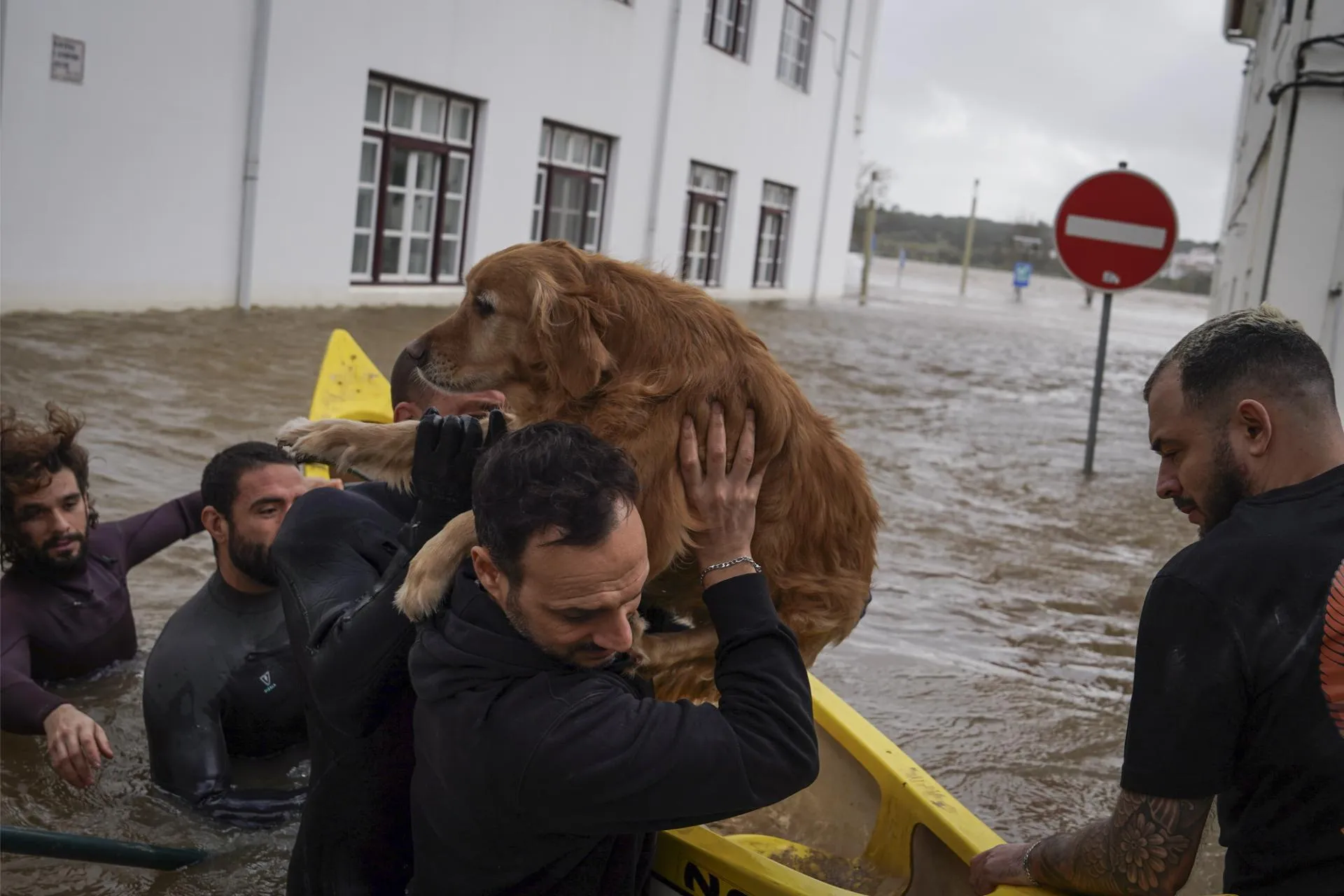
In a moment of crisis, centralization creates a focal point that prevents the duplication of efforts and the waste of limited resources, such as time and fuel. More than a mere technological solution, it proved that structuring data is a profound form of respect for the urgency of those in need.
However, amid all the mapping efforts, there was a glaring gap: the platform did not address the plight of hundreds of animals that, terrified by the storm’s violence, fled their homes that same morning, leaving families in absolute despair. It was from this frustration and immediate necessity that I decided to create @perdidos.tempestade.leiria a digital solution designed to be fast, centralized, and capable of organizing hope for those searching for their pets.
A Compass in the Dark
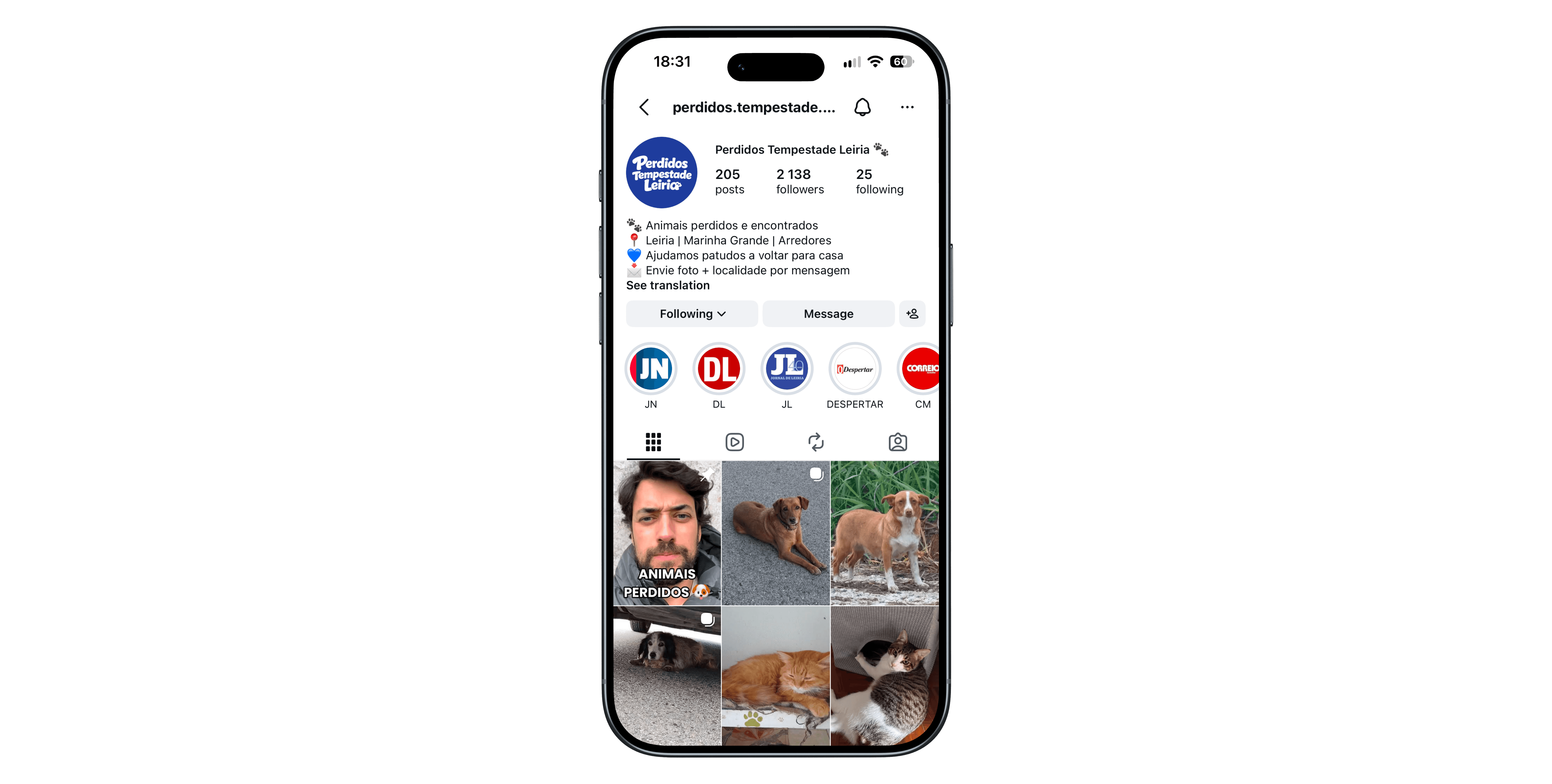
The project’s genesis was rooted in a painful realization: information was fragmenting at a staggering pace. In the critical days following the storm, anyone who lost or found an animal turned to the usual channels — dozens of local Facebook groups, individual profiles, and animal protection association pages. The result was a digital labyrinth.
Adding to this was the physical reality on the ground. In Leiria, mobile communications were practically non-existent. Affected communities had to travel to very specific locations in their towns just to catch a faint internet signal. In those brief minutes of connectivity, it was imperative they didn’t waste their precious, limited mobile data jumping from page to page. They needed a single destination they could trust to be updated by the minute.
Working from Lisbon, with the privilege of uninterrupted access to electricity and the internet, our team took on that role. We became the active, up-to-date voice for those on the ground who were still trying to survive in a literal “apocalyptic” mode. Taking care of our community from a distance became our primary purpose.
Solution Architecture: Why Instagram?
Choosing Instagram as the operation’s “headquarters” wasn’t a matter of aesthetics; it was a meticulously considered decision of information architecture and crisis management:
Structural Resilience: Building a website from scratch would consume vital time and carry the risk of server collapse under traffic spikes (as happened with other initiatives). Instagram provided a bulletproof infrastructure that wouldn’t easily go down.
Efficient Visual Catalog: The platform acts as a flawless visual catalog. Through micro-interactions, users could quickly view photos of the animals with minimal data consumption. Furthermore, the page was accessible and searchable even by those who didn’t have a social media account.
The Multiplier Effect and Instant Sharing: Because it is the network where the overwhelming majority of the community was already active, the platform’s mechanics facilitated massive organic replication. The fluid sharing capability through Stories turned every user into an instant amplifier, spreading views and allowing the message to scale exponentially across their own networks in a matter of seconds.
The Power of the Algorithm: We knew perfectly well how the algorithm reacts to content featuring dogs and cats, boosting its reach due to the natural empathy they generate. We leveraged this metric to “hack” the algorithm for good, multiplying shares and quickly reaching thousands of people.
Monitoring: Native analytics tools allowed us to accurately understand our traffic and the real impact of our reach.
The Invisible Co-Pilot: Artificial Intelligence
Managing hundreds of desperate messages demanded a processing speed that human effort, in isolation, could not keep up with. This is where Artificial Intelligence stepped in as the true driving force of our task force.
AI was present from minute one. It helped us fast-track the project’s foundations, from the immediate choice of the name to the logo design. But its most vital role was in the operational response.
People who have just lost their home or pet do not write structured texts. We received messages in a state of panic, audio recordings, and completely scattered information. To overcome this hurdle, we created a specific prompt. The team simply inputted the raw information sent by users, and the AI processed and structured the text instantly.
The machine generated hyper-detailed descriptions and applied a consistent, universally readable visual signage (🔴 for missing, 🟢 for found, and 🔵 for happy endings — the long-awaited reunions with owners). In mere minutes, chaotic information was transformed into a crystal-clear alert and went online.
The Line of Defense: Triage and Anti-Fraud Security
The speed provided by AI allowed us to direct our time and humanity toward what truly mattered: security.
We assumed the role of a protective shield. In a moment of extreme vulnerability for families, we acted as triage and anti-fraud agents. Data cross-referencing was not done in the public square. We called people, confirmed details, and conducted rigorous vetting before allowing any exchange of contacts between those who lost and those who found an animal. Social responsibility and an uncompromising respect for privacy were our non-negotiable baselines.
The Power of Civic Tech
What was born as an immediate response to a crisis validated the immense power of Civic Tech. The results exceeded all expectations:
The page shattered the impressive mark of 1,009,059 views, reaching 85,326 distinct accounts.
A single Reel, resulting from a collaborative effort with the Despolariza page, went viral with over 400,547 views.
The initiative’s rigor earned recognition from national media outlets. The project’s motivation was highlighted on television, on SIC’s Estamos Juntos program, and received extensive coverage in the written press ( Jornal de Notícias, Jornal de Leiria, O Despertar, Diário de Leiria, Região de Leiria, the PiT platform, and Medialivre group titles such as the NOW channel, Correio da Manhã, Sábado magazine, and Flash!).